
You open your course portal after work and see the word missing beside an assignment you thought was due tomorrow. Perhaps the submission link is still open. Perhaps it has closed. Either way, repeatedly refreshing the page will not tell you what to do next.
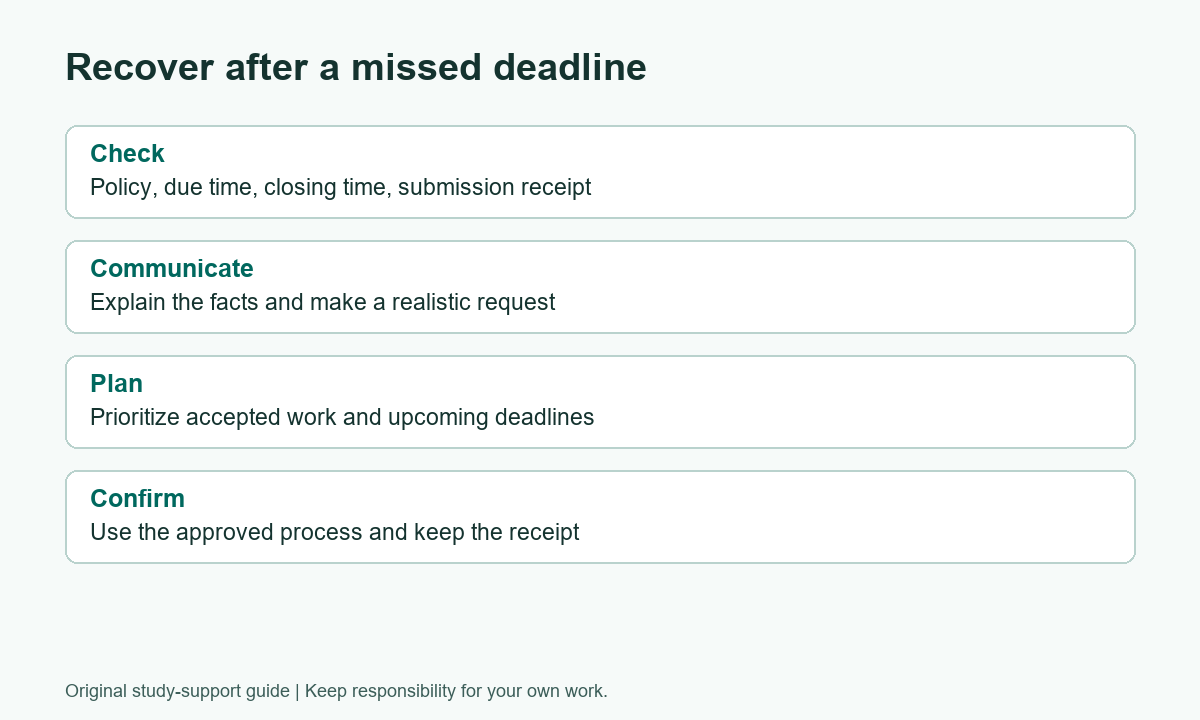
If you missed an assignment deadline, check the written course policy, establish the actual submission status, and contact your instructor through the required channel with an honest, specific request. Then make a plan that protects upcoming deadlines while you wait for a decision.
Late-work rules differ between courses. This guide cannot promise an extension or restored credit. It can help you gather the relevant facts, write a clear message, and recover without inventing an excuse or handing your coursework to someone else.
Check what actually happened before sending a message
Start with the assignment page, syllabus, recent announcements, and any written extension already granted. Record the due date and time, course time zone, late-work policy, permitted attempts, and any final closing date.
Then check your submission history. Uploading a file is not always the same as completing the platform’s submission steps. Look for a receipt, timestamp, confirmation screen, or submitted file that you can open. If you selected the wrong document, note what was submitted rather than describing the assignment as completely missing.
For Canvas, the due date and the last availability date can differ. The official student assignment guide explains these dates and the closed state. An open submission link does not cancel the instructor’s late penalty or guarantee that the work will be accepted.
Do not try to change timestamps, bypass a locked activity, or use another student’s submission. A straightforward explanation gives the instructor usable information; a technical workaround can create a separate academic-integrity problem.
Decide which situation matches yours
The assignment is complete and submissions remain open
Read the policy first. If it permits late submission through the open link, submit your own completed work using the required process and verify the receipt. Send a brief message if the course requires one or if you need to clarify a specific issue.
Do not wait for an email response while an allowed submission window is closing. On the other hand, if the instructions say to obtain permission before submitting late, follow that instruction rather than assuming a general rule applies.
The work is complete but the link is closed
Save your completed file and any genuine evidence of the issue. Ask whether the instructor will accept a late submission and which channel to use if permission is granted. Do not assume that emailing an attachment counts as an accepted submission.
If there was an actual platform error, provide the time, the action you attempted, and the message shown. Contact the institution’s support desk where appropriate and retain the ticket number. Do not describe a deadline misunderstanding as a system outage.
The assignment is not finished
Estimate the work still required before requesting a new deadline. A proposal you can realistically meet is more useful than “I will finish it as soon as possible.” Include other deadlines, your work schedule, and the instructor’s response window in that estimate.
If late work is not accepted, ask which remaining course activities you should prioritize. The answer may be to concentrate on future assignments rather than spend every available hour on work that cannot receive credit.
How to email your professor after a missed deadline
Use the communication method specified in the syllabus. That may be your university email account or an LMS message. Include your name, course and section, assignment name, and one clear request.
The University of Illinois Writers Workshop recommends checking course materials first and communicating concisely. The practical goal is to make your situation easy to identify without sending a long personal narrative.
Explain the relevant context truthfully, acknowledge the applicable policy, and avoid demanding a particular outcome. You can be honest without including private medical, family, or employment details that the instructor has not requested through an appropriate process.
The following original templates are starting points. Replace every bracketed field and remove any sentence that does not accurately describe your circumstances.
Template: requesting a realistic late-submission option
Subject: [Course and section] — [Assignment name] late-submission request
Dear Professor [Last name],
I am [Your name] in [Course and section]. I missed the [date and time] deadline for [Assignment name]. [Brief, truthful context if relevant.]
I reviewed the syllabus and understand that [accurate summary of the late-work rule]. Would you permit me to submit the assignment by [specific proposed date and time], with any applicable penalty?
I have completed [accurate description] and still need to finish [remaining task]. If late submission is not possible, I understand and would appreciate guidance on the next course priority.
Thank you for considering my request.
[Your name]
Template: reporting a genuine submission problem
Subject: [Course and section] — submission issue for [Assignment name]
Dear Professor [Last name],
I am [Your name] in [Course and section]. At [actual date and time], I attempted to submit [Assignment name] and received [exact error or accurate description]. The current submission status shows [what you can verify].
I have [a genuine screenshot, receipt, or support ticket, if available]. Could you advise which submission process I should use and whether any additional information is needed?
I understand that you will determine how the course policy applies.
Thank you,
[Your name]
Neither message guarantees an exception. Do not invent an outage, create misleading evidence, or claim that a file was complete before the deadline unless you can honestly support that statement.
Build a recovery plan without creating another missed deadline
Make a single list of the overdue task and all upcoming work. Include discussion replies, publisher assignments, quizzes, and separate submission components that might not appear together in your main calendar.
For each item, record its deadline, whether it is still accepted, the next concrete action, and a realistic estimate of the time needed. Use course requirements and confirmed instructor guidance to decide priority, not just whichever task feels most uncomfortable.
| Task state | Useful next action | What to avoid |
|---|---|---|
| Late submission allowed | Complete and submit through the approved process | Assuming an open link means no penalty |
| Permission pending | Plan a limited work block and protect upcoming deadlines | Waiting indefinitely without doing other work |
| Late work not accepted | Confirm the decision and focus on remaining requirements | Repeatedly demanding an exception |
| Instructions unclear | Identify one specific question for office hours | Asking someone else to complete the work |
For broader portal organization, see the site’s online learning platform guide. Use its planning ideas within your own course’s actual policies.
Use the next week to regain control
Today: establish the facts and communicate
Check the policy and submission state, send any necessary message, and add the next deadline to your calendar. Save a copy of what you sent so you do not accidentally give different accounts through multiple channels.
Your next study block: start the next accepted task
Choose a specific action you can finish: read the prompt, outline one section, solve a practice set, or gather the required sources. “Catch up on everything” is not a usable action and makes progress difficult to measure.
Before the next deadline: leave time for submission
Plan a personal finishing target earlier than the official deadline. The amount of buffer depends on the assignment, but it should leave time to check the file, upload it, complete the submission steps, and confirm that the correct version was received.
At the end of the week: review the cause
Identify whether the missed deadline came from an incorrect calendar entry, misunderstood instructions, underestimated work, or an ongoing workload problem. Each cause needs a different response. Another reminder will not solve an assignment whose requirements are still unclear.
If you need help making a realistic routine, the study-planning assistance guide provides broader planning context. Any outside support should help you understand and manage your own work.
Seek the right kind of support for a recurring problem
Repeated missed deadlines may require a conversation with an academic advisor, campus learning center, or the relevant student-support office. If an existing accommodation or institutional process applies, follow that process rather than expecting a general email template to resolve it.
An instructor can clarify course expectations, a support desk can investigate a platform issue, and a tutor can explain a difficult concept. Those are different needs. Describe the specific obstacle so you can approach the right person.
For permitted outside tutoring or help interpreting an assignment, contact PayForMyClass about learning support. Request an explanation, planning guidance, or feedback on your own draft. Do not share account credentials or ask someone to submit work in your name.
Frequently asked questions
Can I submit an assignment after the deadline?
It depends on the written course policy, assignment settings, and any instructor-approved exception. Check both the due date and closing date. A platform’s ability to accept a file does not establish that the instructor will award credit.
Should I attach the completed assignment to my email?
Follow the course instructions or ask which submission method is acceptable. An emailed attachment may not count as an official submission. If an instructor approves email submission, keep the message and any confirmation.
What if my professor does not reply immediately?
Check the stated response schedule and continue working on other accepted tasks. Follow up through the prescribed channel after a reasonable interval consistent with that policy. Do not repeatedly send the same request through multiple channels unless directed.
What should I do if late work is not accepted?
Respect the decision, confirm what remaining work can still earn credit, and review your plan with the instructor or advisor if needed. Do not assume that one missed task determines the final grade without understanding the course’s grading structure.
Focus on the next useful action
A missed deadline needs a factual response, not a perfect excuse. Find the relevant rule, communicate honestly, and protect the work you can still complete. Keep records of any new agreement and follow the approved submission process.
When the obstacle is confusing instructions or a difficult concept, ask for support that builds your ability to complete the work yourself. A targeted tutoring or planning inquiry is a more responsible next step than trying to hide what happened.