
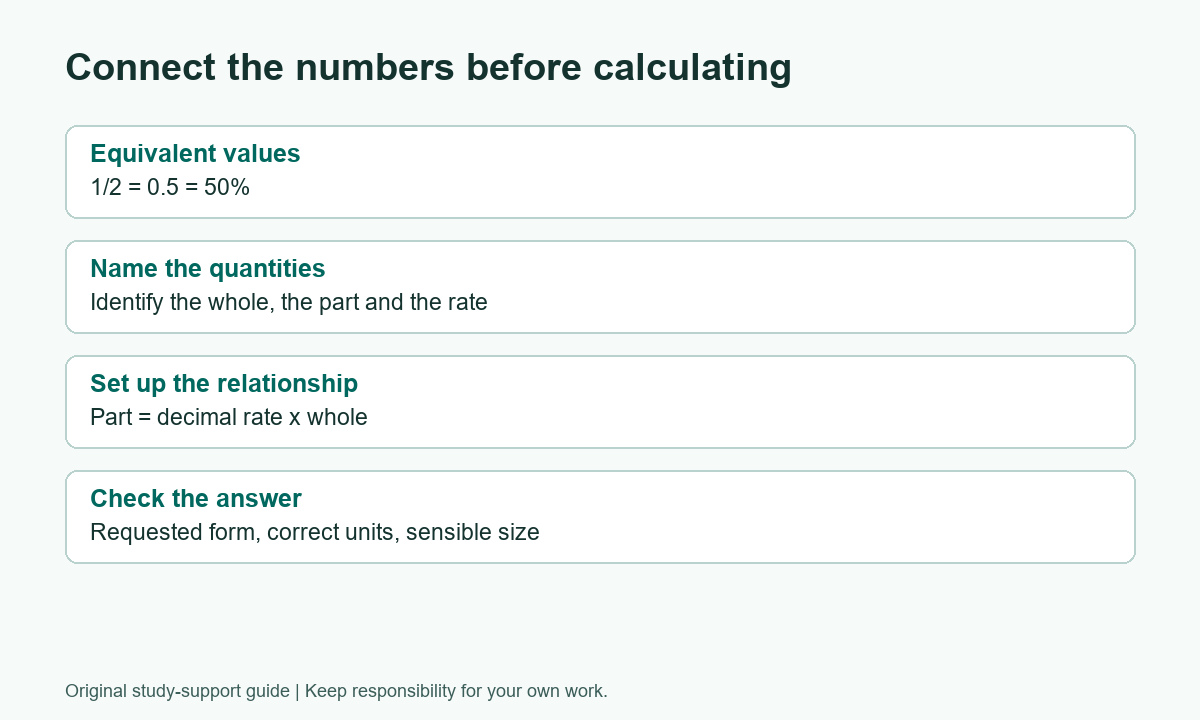
You recognize the math when someone explains it, but a word problem still makes you pause. Should you divide the two numbers? Multiply by the percent? Move the decimal? That uncertainty often comes from switching between different ways of describing the same quantity.
Practicing TEAS fractions, decimals and percentages together can make those connections easier to see. Instead of memorizing a separate trick for every question, learn to identify the whole, the part, and the form the answer must take.
This guide uses original, independently created practice problems. They are not recalled or official ATI exam items, and PayForMyClass is not claiming ATI endorsement. Use the explanations to strengthen your understanding, then check your preparation against current official materials and your nursing program’s requirements.
What should you know about these TEAS math skills?
A fraction, decimal and percentage can represent the same value. For example, 3/4, 0.75 and 75% each describe three quarters of a whole. The important skill is recognizing which form makes a particular calculation easier.
ATI’s official TEAS Version 7 content outline includes converting among these forms, rational-number operations and practical percentage problems. This article focuses on that connected skill group, not the complete math section.
Keep the outline nearby as a scope check. Being comfortable with percentages does not replace preparation for the other math objectives or the reading, science, and English sections.
Convert fractions to decimals and percentages
Divide the numerator by the denominator
To convert a fraction to a decimal, divide its top number by its bottom number. To express that decimal as a percentage, multiply by 100 and include the percent sign.
For 3/8:
- Divide 3 by 8 to get 0.375.
- Multiply 0.375 by 100 to get 37.5.
- Therefore, 3/8 = 0.375 = 37.5%.
Check the scale before accepting the answer. Three eighths is less than one half, so its percentage should be below 50%. An answer of 375% would describe more than three whole units and cannot represent this fraction.
Simplify first when it makes the conversion clearer
Suppose an ungraded practice set has 24 questions and you answer 18 correctly. The fraction correct is 18/24. Dividing both numbers by 6 gives 3/4, which equals 0.75 or 75%.
The original fraction and the simplified fraction describe the same proportion. Simplifying changes the notation, not the amount. It is often useful when you recognize a familiar fraction more quickly than you can perform a longer division.
| Fraction | Decimal | Percentage |
|---|---|---|
| 1/2 | 0.5 | 50% |
| 1/4 | 0.25 | 25% |
| 3/4 | 0.75 | 75% |
| 1/5 | 0.2 | 20% |
| 1/8 | 0.125 | 12.5% |
| 3/8 | 0.375 | 37.5% |
Use the table to check reasoning, not as the only set of conversions you practice. You also need to work through unfamiliar values.
Convert decimals and percentages without losing place value
Decimal to percentage
Multiplying a decimal by 100 expresses it in hundredths. For example, 0.06 = 6%, while 0.6 = 60%. Reading the digits without their place value is a common source of errors.
Say the decimal out loud if it helps: 0.06 is six hundredths. Six hundredths is six percent. It is not sixty percent simply because the same digit appears.
Percentage to decimal or fraction
Divide the percentage value by 100 to get its decimal form. Thus 7% = 0.07, and 125% = 1.25. Percentages can exceed 100 when they describe more than one whole.
For a fraction, begin with the percentage over 100 and simplify. For example, 6% = 6/100 = 3/50. A percentage with a decimal can also become a fraction: 12.5% = 0.125 = 125/1000 = 1/8.
Always identify which form the question requests. A correct decimal may still be an incomplete answer when the prompt asks for a simplified fraction or a percentage.
Choose the right equation for a percent problem
Most basic percentage problems can be organized around this relationship:
Part = decimal rate × whole.
The word problem tells you which piece is missing. Translate the situation into that relationship before calculating.
Example 1: Find the part
A student completes 35% of an 80-page assigned reading. How many pages does that represent?
The whole is 80 pages and the rate is 0.35. Calculate 0.35 × 80 = 28 pages. As a reasonableness check, 35% is a little more than one third, so 28 is plausible.
Do not multiply by 35. That treats the percentage value as a whole-number multiplier instead of 35 hundredths.
Example 2: Find the percentage
A student completes 15 of 60 ungraded review problems. What percentage is complete?
Divide the part by the whole: 15/60 = 0.25. Then multiply by 100 to express the answer as 25%. If you stop at 0.25 and add a percent sign, the result becomes 0.25%, a different amount.
Example 3: Find the whole
Forty-five pages represent 30% of a reading packet. How many pages are in the packet?
Write 45 = 0.30 × whole. Divide 45 by 0.30 to get 150 pages. Check by calculating 30% of 150, which returns 45.
Multiplying 45 by 0.30 would find 30% of the part rather than recovering the original whole. Labeling the known quantity prevents that reversal.
Distinguish a percent change from a percentage-point change
Suppose a practice score increases from 72% to 90%. The increase is 18 percentage points because 90 − 72 = 18.
The relative percent increase uses the original value as its denominator: (90 − 72)/72 × 100 = 25%. These two statements describe different comparisons. Neither should be substituted for the other without checking the question’s wording.
For a price example, a $64 workbook is discounted by 25%. The discount is 0.25 × 64 = $16, and the remaining price is $48. Multiplying by 0.75 also gives $48 because 75% of the original price remains.
An increase works similarly: raising an $80 amount by 15% gives $80 + $12 = $92, or 1.15 × $80. Do not confuse the size of the change with the final amount.
Try these original practice questions
Work through the questions before reading the explanations. Write the requested answer form beside each prompt so you do not overlook it.
- Express 7/20 as a decimal and a percentage.
- Write 0.045 as a percentage.
- Convert 62.5% to a simplified fraction.
- Find 18% of 250.
- Twenty-one completed tasks are 70% of a checklist. How many tasks are on the checklist?
- A price falls from $50 to $40. What is the percent decrease?
Answers and explanations
1. 7/20 = 0.35 = 35%. You can divide 7 by 20, or multiply numerator and denominator by 5 to obtain 35/100. Both methods reach the same value.
2. 0.045 = 4.5%. Multiply the decimal by 100. The result is below 5%, consistent with 0.045 being below 0.05. An answer of 45% is ten times too large.
3. 62.5% = 5/8. Convert to 0.625, write 625/1000, and simplify. Dividing numerator and denominator by 125 gives 5/8.
4. 18% of 250 = 45. Calculate 0.18 × 250. Alternatively, 10% is 25 and 8% is 20, so together they give 45. A second method can help check your arithmetic.
5. The checklist has 30 tasks. Use 21 = 0.70 × whole, then divide 21 by 0.70. Verify that 70% of 30 equals 21.
6. The decrease is 20%. The change is $10, divided by the original $50, then multiplied by 100. Dividing by the new $40 would answer a different comparison.
Keep an error log that tells you what to practice
Record more than the question number and the correct answer. Identify the first incorrect decision: choosing the wrong whole, converting the percent incorrectly, reversing a division, or rounding too early.
Then write one repair rule in your own words. For example: “For percent decrease, divide the change by the original amount.” Solve a fresh question using that rule without looking at the previous explanation.
Review correct answers too. If you guessed or cannot explain the setup, mark the skill for another attempt. An answer can be correct for the wrong reason, which makes later questions harder to handle consistently.
If a step remains unclear, contact PayForMyClass about permitted math tutoring using an original or ungraded practice problem. Ask for an explanation and a new example to solve yourself, not assistance during an assessment.
Fit focused practice into your broader study plan
Use a short session to practice one conversion skill, another to solve mixed word problems, and a later session to revisit earlier errors without notes. A small, carefully reviewed set is more informative than a large set you never analyze.
For overall scheduling, see the TEAS study-planning guide. ATI also provides official preparation-time guidance that emphasizes establishing a baseline and reviewing weak areas. Your starting knowledge, application deadline, and other exam sections determine how much time you need.
Check current official instructions for calculator use and testing rules. Practice should prepare you to work within those rules; it should never depend on prohibited outside assistance.
Frequently asked questions
Are these official TEAS questions?
No. These are original instructional problems created to explain underlying math skills. They are not actual, recalled, leaked, or ATI-authored exam questions. Use official ATI materials to understand the assessment’s current scope and formats.
Why do I keep mixing up 0.6 and 0.06?
They represent different place values: six tenths and six hundredths. Convert each to a fraction or read it aloud before calculating. Connecting 0.6 to 60/100 and 0.06 to 6/100 can make the difference clearer.
Should I round every decimal as soon as I calculate it?
Follow the prompt’s rounding instructions. Rounding intermediate steps unnecessarily can change a final answer. Keep sufficient precision during the calculation, then round the final result as requested and include the correct unit or answer form.
Will mastering these skills guarantee a passing TEAS score?
No. These skills cover only part of the assessment. Admission requirements, preparation needs, and results vary. Use a broader diagnostic and the official outline to identify other topics you need to study.
Make the setup your first priority
Before calculating, identify the whole, the part, and the answer form. Afterward, check whether the size of your result makes sense. Those habits make your practice more useful than memorizing isolated shortcuts.
For learning support, explore the site’s guide to online math learning or request a tutoring inquiry through the contact page. Keep the work focused on understanding and independent practice, with no promises about grades or exam results.