
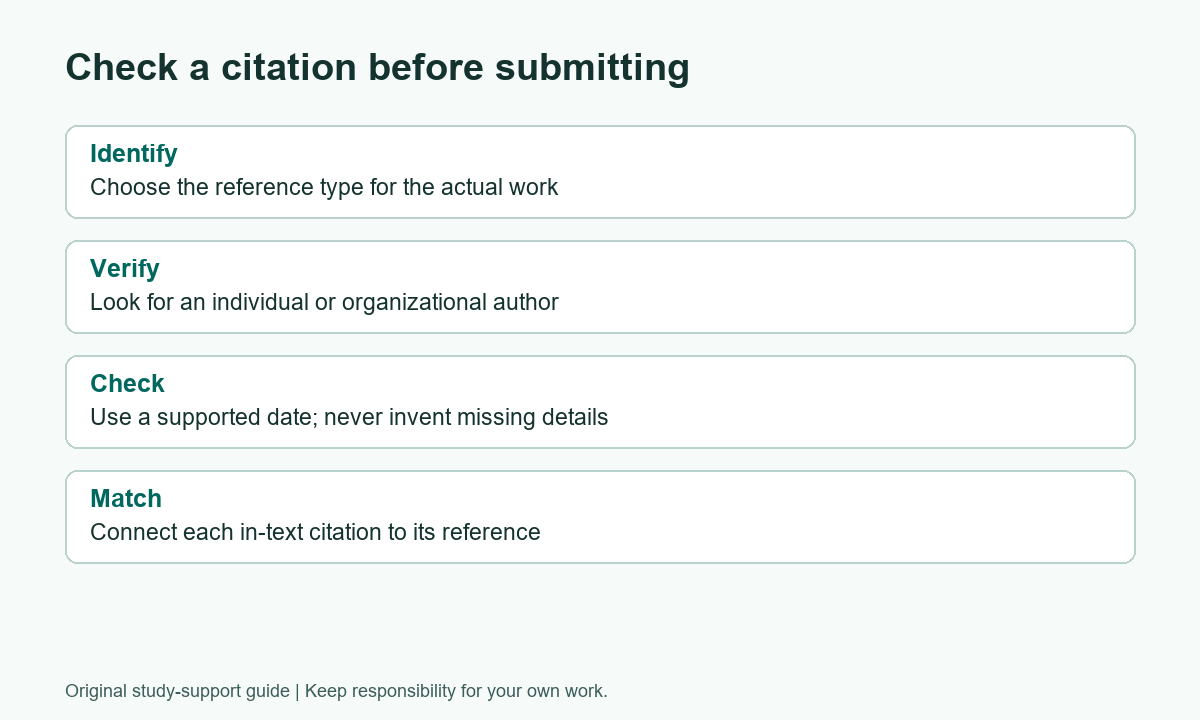
You have a useful source open, but there is no byline, no obvious publication date, or neither. A citation generator fills the gaps confidently. Should you trust it?
For an APA citation with no author or date, verify the original source first. If the author is genuinely missing, the title takes that position. If the date is missing, use n.d. Do not invent either detail. The exact reference format still depends on what you are citing.
This APA 7 guide is for US college and graduate students checking their own papers. It separates the formatting decision from an equally important question: whether the source is suitable evidence for the assignment.
Start with the work, not the browser tab
A PDF can contain a journal article, a report, a book chapter or a handout. These do not automatically share the same reference format. Likewise, a university website can host a staff biography, an institutional report and a research article.
Before editing punctuation, write down what the work actually is. Look for a report cover, journal name, volume, issue, publisher or other identifying information. Follow your instructor’s required style edition and any assignment-specific directions.
Keep a small source record while you work:
- Type of work and exact title.
- Credited individual or responsible organization.
- Publication date or clearly applicable update date.
- Publisher, website or journal information as appropriate.
- Stable URL or DOI, when relevant.
- Location of the passage you actually used.
This record makes it easier to catch an incorrect generator entry without repeatedly reopening twenty tabs. If you are organizing a longer project, a literature review matrix can hold the source information alongside your notes about its argument and limitations.
Check whether the author is really missing
No personal byline does not necessarily mean no author. A report may credit a department, association or agency. Check the first page, title page, page heading and any clearly identified authorship statement before choosing a no-author format.
Do not automatically promote the website owner, domain name or a person quoted in the work into the author field. You need a defensible connection between the credited author and that particular work.
Imagine a fictional campus learning office publishes its own study-planning webpage. If the office is responsible for the page, an organizational author may be appropriate. That is a different situation from an unsigned guest submission merely hosted on the same domain.
APA’s webpage reference examples explain organizational authorship and the treatment of website names. When the organizational author and website name are identical, the site name is omitted to avoid repeating it.
Do not use Anonymous as a placeholder
“Anonymous” is not a label for an author you could not find. Use it only when the work itself is signed that way. A blank author field in a citation tool is a prompt to investigate, not permission to create a name.
For a genuinely authorless work, APA’s missing reference information guidance moves the title into the author’s position. A genuinely missing date is represented by n.d.; when both are absent, those two adjustments work together.
Check whether the date belongs to the content
A year in the website footer may describe the site as a whole. A search result may display a date without explaining what it represents. Neither should automatically become the publication year of the work you are citing.
Look for a publication date beside the title, a date on the report itself, or an update clearly tied to the content. A “last reviewed” label is not necessarily a publication or revision date. APA’s webpage guidance distinguishes a substantive content update from a review date.
If no applicable date can be established, use n.d., including the periods. Do not substitute the current year, the year you downloaded the file or a date produced by a chatbot.
Keep a note of where you looked. This is especially useful when a group project partner asks why you used n.d. You can explain the decision instead of relying on a tool’s output.
Fictional APA examples: author, date or both missing
All names and titles in this section are fictional teaching examples. “Actual source URL” is a placeholder, not a real reference or evidence for your paper. Replace the example details only with information verified from your own source.
The examples use standalone reports and an organizational webpage. Other work types may need different source elements and title formatting.
Example 1: organizational author, no date
Reference pattern for the fictional webpage:
Campus Learning Office. (n.d.). Planning a study week. Actual source URL
Parenthetical citation: (Campus Learning Office, n.d.)
Here, the organization is credited as the author. The title is italicized and in sentence case. Because the fictional website name is also Campus Learning Office, it is not repeated after the title.
Example 2: no author, known date
Reference pattern for a fictional standalone report:
Student study spaces: A campus planning report. (2025). Example Campus Press. Actual source URL
Parenthetical citation: (Student Study Spaces, 2025)
The report title replaces the missing author. The shortened in-text title uses title case and italics because this example is a standalone report. The reference retains the full title in sentence case.
Example 3: neither author nor date
Reference pattern for a fictional standalone report:
Evening study access: A planning brief. (n.d.). Example Campus Press. Actual source URL
Parenthetical citation: (Evening Study Access, n.d.)
The title and n.d. work together. You have not claimed to know an author or year that the source does not provide. However, you still need to decide whether an undated, unsigned report deserves a place in your assignment.
Match title formatting to the work
Do not copy the report example’s italics into every citation. A journal article or chapter is part of a larger work and needs its own format. The title used in the text must also identify the matching reference clearly.
For further examples of title-based citations and missing dates, consult Purdue OWL’s author and in-text citation guide. When a short guide leaves an edge case unclear, check the relevant APA example and ask your instructor or librarian before submitting.
Missing information does not establish source quality
A citation can be formatted correctly and still support a weak argument. Before keeping an unsigned or undated source, ask what job it performs in the paper.
For a current policy claim, you may need the responsible agency’s current policy document. For a claim about a research finding, you may need the original study rather than an unattributed summary. For a historical analysis, an older or incomplete document might be the very object you are studying.
Use this decision table as a research check, rather than a rule that all incomplete sources must be rejected.
| What you find | Next useful step |
|---|---|
| No byline, but clear organizational responsibility | Verify the organization and choose the appropriate reference example |
| No date for a time-sensitive claim | Look for current primary evidence or discuss the limitation |
| A claim with no traceable supporting research | Find the original evidence before relying on the claim |
| Conflicting versions of a report | Identify the version actually read and used |
| Neither a reliable source nor a recoverable origin | Consider replacing it with evidence you can verify |
If your instructor requires peer-reviewed sources, a polished organizational webpage may not satisfy that requirement. Check the rubric before spending time perfecting a reference you cannot use.
A practical citation-checking routine
Pass 1: compare the entry with the original
Open the original work beside your reference list. Check author, date, title and source separately. Verify a DOI by opening it and comparing the landing page with the work you read. Do not accept a familiar-looking title as proof that every other field is correct.
Citation software is useful for storing and arranging information, but an imported entry can have the wrong item type or incomplete fields. Correct those fields in your reference manager so the next bibliography export does not restore the mistake.
Pass 2: connect the reference to your sentence
Find the sentence that uses the source. Confirm that its citation points unmistakably to the intended entry. If you replaced a guessed author with a title, update the in-text citation too.
Then check the claim itself. Does your wording preserve the source’s meaning and limitations? A correctly formatted reference cannot repair an exaggerated paraphrase or a quotation that was never in the work.
Pass 3: check the finished submission
Review the exported document, not just your reference-manager screen. Confirm that italics, hanging indents and links survived the export, and that the reference list follows your assignment’s formatting requirements.
Keep these checks separate from general proofreading. Reading only for grammar makes it easy to miss an author-date mismatch.
Using AI without inventing references
Treat an AI-generated reference as an unverified suggestion. Locate and read the real source before citing it. If the title, author, year or DOI cannot be matched to an actual work, do not insert the generated entry into your bibliography.
A useful assistance request is: “Here are the source details I verified. Which required fields should I check next?” A risky request is to fill unknown fields with plausible information so the entry looks complete.
Follow your course’s AI-use and disclosure rules. Keep your source selection, interpretation and final writing under your own control. If you need feedback on your own draft, ask about permitted citation or editing support, sharing the rubric and the specific problem without sharing account credentials. Confirm that any assistance fits your institution’s policy.
Frequently asked questions
Can an organization be the author in APA 7?
Yes. An organization can be the author when it is responsible for the work. Verify that responsibility on the source rather than assuming the website owner wrote every page it hosts.
What does n.d. mean in an APA citation?
It means no date. Use n.d. when an applicable publication date cannot be established after checking the source. It does not mean the current year or the year you accessed the work.
Should I add a retrieval date because there is no publication date?
Not automatically. APA calls for retrieval dates for content designed to change over time that is not archived. Missing a publication date alone does not establish that condition; check the reference example for the work.
Is a citation generator enough to finish my reference list?
No. Compare its entry with the original source, check the work type and missing fields, and match the final entry to your in-text citation. You remain responsible for the accuracy of the submitted references.