
You have a dissertation topic, a folder of articles, and one persistent comment from your advisor: “What, exactly, are you trying to find out?”
That question signals a decision you still need to make. A subject such as online learning gives you a field to explore. A research question identifies the particular uncertainty your study will investigate and the evidence you will need.
The dissertation research question examples below show how to make that transition. They are original teaching examples, not completed studies or proposals ready for submission. Use their reasoning to develop your own question, then check it against your program’s requirements and your advisor’s feedback.
What makes a dissertation research question workable?
A workable research question identifies a focused uncertainty that you can investigate with appropriate evidence, within your available time and resources. It also needs a defensible reason to matter in your discipline.
A question can sound impressive and still be impossible to answer. “How can universities eliminate student stress?” promises a solution across institutions, populations, and circumstances. One dissertation is unlikely to support that promise.
Ask yourself:
- What specific issue needs explanation, interpretation, comparison, or measurement?
- What literature establishes that the issue deserves investigation?
- Which people, documents, settings, or systems will the study examine?
- What evidence could answer the question?
- Can I obtain and analyze that evidence through an approved process?
For doctoral work, explain the intended scholarly contribution; narrowing a question alone does not establish originality. Master’s theses and professional doctoral projects may have different expectations. Your handbook and committee determine the required scope.
Move from a broad topic to a focused question
1. Identify the problem behind your topic
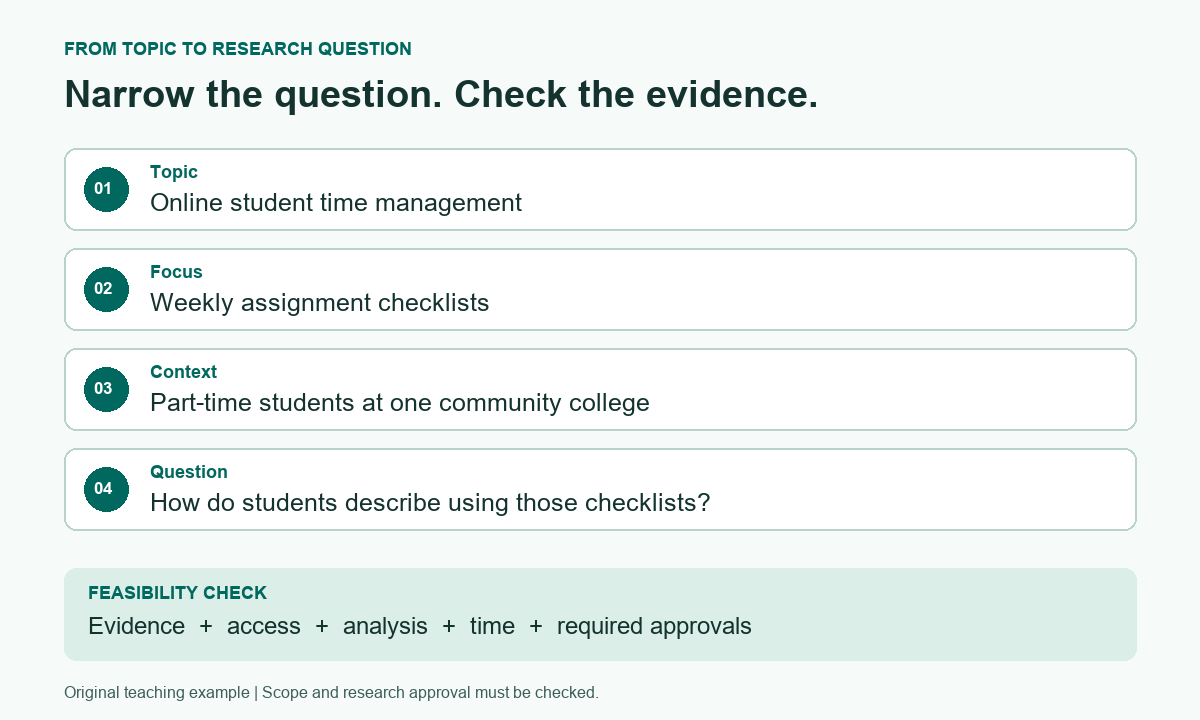
Suppose your interest is time management among online students. That still leaves many possible projects: scheduling apps, assignment design, employment demands, or communication with instructors.
Choose a problem you can explain precisely. For example, you might investigate how students interpret weekly assignment checklists. At this point, that is a possible research direction, not a proven gap.
If you are still comparing subject areas, the site’s guide to choosing a research paper topic can help with initial brainstorming. Dissertation proposals require a further check of contribution and feasibility.
2. Use reading to test your assumptions
Search your university’s databases using the problem, related terms, and the relevant population or setting. Record what earlier studies examined, how they gathered evidence, and what remains uncertain.
Do not claim “nobody has studied this” because one search found little. Try alternate terminology and ask a subject librarian for help. A contribution might involve testing an explanation in a different context, examining a disagreement, or improving how a concept is understood.
The University of Michigan Library’s research-question guidance emphasizes researchable questions and revising scope as you learn more from the literature.
3. Set boundaries that serve the question
For an empirical study, useful boundaries may include population, setting, phenomenon, and timeframe. For historical or textual research, they may include a defined archive, group of texts, period, or interpretive lens.
You do not need to squeeze every boundary into one sentence. Define essential terms in the proposal. However, “students,” “success,” and “technology” usually need more explanation than their everyday meanings provide.
4. Write down the evidence route
Under your draft question, complete this sentence:
“To answer this, I would need ___, which I could obtain through ___.”
If you cannot finish it convincingly, the question needs more work. A manageable-sounding project can become unworkable when it depends on private records, unavailable participants, or permissions you cannot obtain in time.
Five dissertation research question examples
These hypothetical examples illustrate scope and evidence choices. None establishes a research gap, an appropriate sample size, or committee approval.
Example 1: Education and online coursework
Broad topic: Time management in online college courses.
Focused question: How do part-time students at one Midwestern community college describe using instructor checklists to plan weekly online coursework?
The question identifies a group, setting, and specific practice. Interviews could explore how students interpret and use checklists. They would not, by themselves, establish that checklists improve grades or cause better time management.
Feasibility check: Can you obtain institutional permission and recruit participants appropriately? How will you define part-time enrollment and checklist use? Avoid recruiting your own students without addressing the potential pressure to participate.
Example 2: Business communication
Broad topic: Sustainability and customer trust.
Focused question: How do regional US banks explain their climate-related lending commitments on public sustainability webpages published during a defined two-year period?
This question examines communication rather than assuming how customers respond. A documented content-analysis approach could compare a clearly defined set of public pages.
Feasibility check: Specify which banks qualify, how pages will be selected, and how changing webpages will be recorded. Public statements cannot establish actual lending performance or customer trust. Those would require different evidence.
Example 3: Quantitative student research
Broad topic: Work and academic well-being.
Focused question: What is the association between weekly paid-work hours and self-reported academic confidence among undergraduate commuters at one public university?
The question names two concepts that could be measured. A survey might examine an association, subject to appropriate measurement, sampling, and analysis decisions.
Feasibility check: Define academic confidence using a justified measure. Discuss relevant confounding factors with your advisor. A cross-sectional association would not establish that employment causes confidence to rise or fall, and one university would limit generalization.
Example 4: Engineering simulation
Broad topic: Efficient campus cooling.
Focused question: How does changing the modeled occupancy schedule affect simulated annual cooling demand in a specified university classroom building, with other model inputs held constant?
The question creates a bounded comparison and identifies a measurable output. It may suit a simulation study if the modeling assumptions and evaluation process meet the program’s standards.
Feasibility check: Confirm access to software, building specifications, and suitable weather data. Plan sensitivity checks and validation. Simulated results are not measured energy savings and should not be presented as guaranteed real-world performance.
Example 5: Humanities and public documents
Broad topic: Education and civic identity.
Focused question: How do first-year orientation speeches at two US public universities construct the idea of civic responsibility during a defined five-year period?
The focus is a bounded collection of texts and an interpretive problem. A humanities dissertation may organize its question around texts, concepts, or historical arguments rather than variables or participant populations.
Feasibility check: Establish that the speeches are accessible and comparable. Explain your selection criteria and interpretive approach. The texts cannot, without additional evidence, reveal what students believed or how they behaved afterward.
Match the question to the research design
Question wording should describe what your design can support.
| What you want to understand | Possible evidence route | Important limit |
|---|---|---|
| Experiences or interpretations | Interviews, observations, or relevant documents | Findings depend on context and analytic approach |
| Patterns or associations | Appropriate measurements and quantitative analysis | Association does not establish causation |
| Effects of an intervention | A justified causal design and comparison strategy | Causal claims need more than stronger wording |
| Meanings in texts or artifacts | A defined corpus and interpretive framework | Interpretation must be supported by the material |
| Performance under specified conditions | Experiments, simulations, or design evaluation | Results depend on assumptions and evaluation criteria |
These are starting points, not automatic assignments of method. Mixed methods require a reason for combining evidence, along with sufficient time and expertise. Do not add interviews to a survey simply to make a proposal seem more substantial.
For the larger sequence of proposal development, research, and revision, see the online dissertation planning guide.
Check feasibility before committing
Create a one-page note with six headings: question, contribution, evidence, access, analysis, and schedule. Write specific answers rather than “I will collect data later.”
Under access, name the permission or resource you need and a fallback if it is unavailable. Under analysis, identify what you need to learn and who can advise you. Under schedule, include recruitment or document collection, analysis, revision, and advisor feedback time.
For research involving people or identifiable information, follow your institution’s human research protection procedures before recruitment or data collection. Ask the relevant office to determine the applicable review pathway; do not assume that a class project or low-risk survey is automatically exempt. HHS guidance explains the role of institutional review offices.
If the schedule does not work, revise the scope with your advisor. Removing a setting or narrowing a corpus may be sensible. Reducing a sample without methodological justification is not a substitute for a feasible design.
Prepare for your next advisor meeting
Bring a working question, a short explanation of its contribution, the key sources you have read, and your evidence route. Identify the decision you need help making.
Useful questions include:
- Is this contribution appropriate for my degree and discipline?
- Which term or boundary needs a clearer definition?
- What would prevent this evidence from answering the question?
- Which permission, method, or analysis decision should I resolve first?
Afterward, save the revised question with a date and note how it changes your reading or design. This prevents different chapters from quietly drifting toward different questions.
If your own proposal needs clearer language or organization, review PayForMyClass’s dissertation editing support. Ask specifically about feedback on your existing writing, within your university’s rules. Keep responsibility for the research question, analysis, and submitted work yourself.
Frequently asked questions
How many research questions should a dissertation have?
There is no universal number. Some projects use one main question with supporting questions; others use an approved multi-study structure. Each question needs a clear role, evidence route, and place in the final argument. Follow your department’s requirements.
Can a dissertation research question change?
Yes, particularly during early reading and proposal development. Discuss substantive changes with your advisor. If an approved study involves human participants, ask the relevant review office whether changes require an amendment before you implement them.
Does every research question need a hypothesis?
No. A hypothesis is a testable expectation, which may suit some quantitative designs. Exploratory, interpretive, and other projects may use research questions without hypotheses. Your research purpose and disciplinary approach determine what is appropriate.
How do I know whether my question is too broad?
Try listing the evidence needed for a convincing answer. If it spans many populations, unrelated outcomes, or inaccessible settings, narrow the scope. If you cannot identify sufficient relevant literature or meaningful analysis, it may be too narrow instead.
Your next step
Choose one question you can explain, justify, and investigate. Test it against the literature, realistic access, and your program’s expectations before building the whole proposal around it.
When you need feedback on the clarity of your own draft, contact PayForMyClass about permitted editing support. Include your discipline, the feedback you need, and your deadline; do not send account credentials or confidential participant information. Your advisor remains the authority on whether the proposed study meets your program’s requirements.